

What is a 529 plan?
A 529 plan is a tax-advantaged, state-sponsored investment plan designed to help families save for a beneficiary’s education expenses. Originally focused on college, these plans have evolved significantly, becoming one of the most flexible tools for lifelong learning and financial planning.
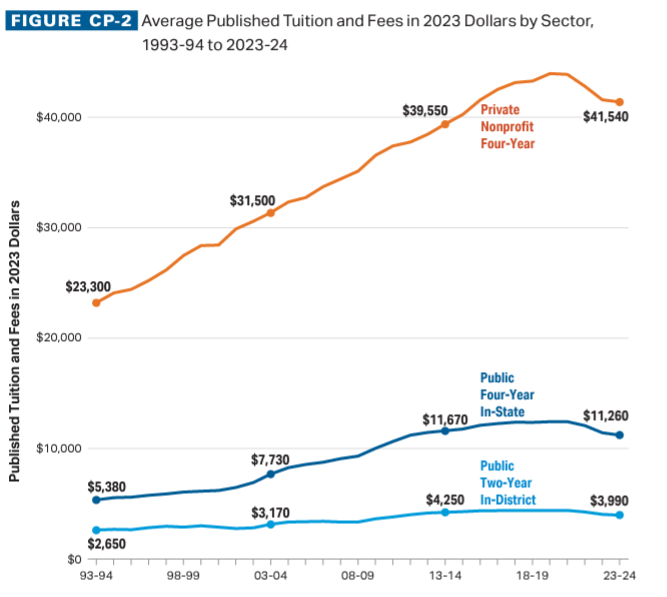
In the past 30 years, college expenses have skyrocketed. Between 1996 and 2026, inflation-adjusted tuition and fees more than doubled at public four-year institutions. According to the College Board, for the 2025–26 academic year, the average “sticker price” for tuition and fees is:
- Public four-year in-state: $11,950 (up 2.9% from the previous year).
- Public four-year out-of-state: $31,880 (up 3.4% from the previous year).
- Private nonprofit four-year: $45,000 (up 4.0% from the previous year).
With these rising costs, 529 plans are more essential than ever for avoiding the “student debt trap.
In this article, I will share how the 529 plan can help you send your kids or grandkids to college.
Student Debt Continues to Grow
Total U.S. student debt has surged to over $1.8 trillion in 2026, held by approximately 45 million borrowers. The average federal student loan debt per borrower now exceeds $39,500.
Despite these daunting figures, 529 plans are gaining momentum. As of 2026, there are over 17.4 million 529 accounts with a total of $588 billion in assets. The average account balance has grown to approximately $31,000, showing that more families are proactively saving rather than relying solely on loans.
Let’s break down some of the benefits of the 529 plan.
College Savings Made Easy
Nowadays, you can easily open an account with any 529 state plan in just a few minutes and manage it online. You can set up automatic contributions from your bank account. Also, many employers allow direct payroll deductions, and some even offer a match. Your contributions and dividends will be invested automatically, so you don’t have to worry about it yourself. As a parent, you can open a 529 plan with as little as $25 and contribute as low as $15 per pay period. Most direct plans have no application, sales, or maintenance fees. 529 plan is affordable even for those on a modest budget.
529 plan offers flexible Investment Options
Most 529 plans provide a wide variety of professionally managed investment portfolios, including age-based, indexed, and actively managed options. The age-based option is an all-in-one portfolio series intended for those saving for college. The allocation automatically shifts from aggressive to conservative investments as your child approaches college age.
Alternatively, you can design your portfolio by choosing between a mix of actively managed and index funds that match your risk tolerance, timeline, and investment preferences. Some 529 plans offer guaranteed options, which limit your investment risk but also cap your upside.
Earnings Grow Tax-Free
The 529 plan operates much like a Roth IRA. You contribute after-tax dollars, but your earnings grow 100% tax-free at the federal level. When you withdraw the money for “qualified education expenses,” you pay zero taxes on the gains.
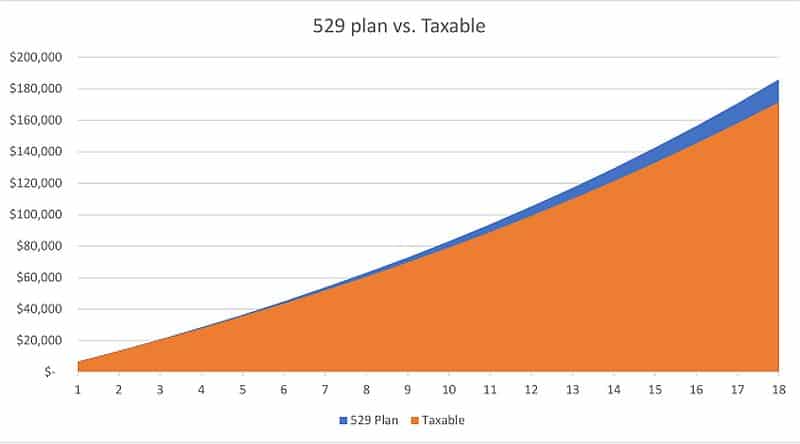
Tax-Exempt Growth Example: If you contribute $6,300 annually with a 5% return over 18 years, you could save over $15,000 in taxes compared to a standard taxable brokerage account (assuming a 20% tax rate).
Tax-exempt growth
Your State May Offer a Tax Break
Over 30 states offer a full or partial tax deduction or credit on your 529 contributions. You can find the full list here. If you live in any of these states, your 529 contributions can lower significantly your state tax bill. However, these states usually require you to use the state-run 529 plan.
If you live in any of the remaining states that don’t offer any state tax deductions, such as California, you can open a 529 account in any state of your choice.
Use at Schools Anywhere
You can use 529 funds for any accredited university, college, or vocational school nationwide and more than 400 schools abroad. Basically, any institution eligible to participate in a federal student aid program qualifies. A 529 plan can be used to pay for tuition, certain room and board costs, computers and related technology expenses, as well as fees, books, supplies, and other equipment.
The TCJA law of 2017 expanded the use of 529 funds. It allowed parents to use up to $10,000 annually per student for tuition expenses at a public, private, or religious elementary, middle, or high school. However, please check with your 529 plan, as not all states passed that provision.
Smaller Impact on Scholarship and Financial Aid
Many parents worry that 529 savings can adversely affect eligibility for scholarships and financial aid. Fortunately, 529 plan savings have no impact on merit scholarships. You can even withdraw funds from the 529 plan penalty-free up to the amount of the student scholarship.
For FAFSA, funds are typically treated as ownership of the parent, not the child, reducing the impact on financial aid application. A key component of the financial aid application is the Expected Family Contribution (EFC). Since 529 plans are considered parents’ assets, they are assessed at 5.64% of their value. For comparison, any accounts owned directly by the student such as custodial accounts (UTMAs, UGMAs), trusts and investment accounts are assessed at 20% of their value.
More Ways to Use Your Funds
The definition of “qualified expenses” has expanded significantly in recent years:
- K–12 Education: Thanks to the One Big Beautiful Bill Act of 2025, the annual withdrawal limit for K–12 tuition doubled. Families can now use up to $20,000 per year per student for private or religious elementary and high school tuition.
- New K–12 Perks: Beyond tuition, you can now use funds for tutoring, standardized test fees, and curriculum materials (including for structured homeschooling).
- Apprenticeships & Trade Schools: Funds can be used for any program registered with the U.S. Department of Labor.
- Credentialing: You can now use 529 money for professional certifications and licenses (e.g., CPA exams, bar exams, or nursing credentials).
- Student Loan Repayment: You can use a lifetime maximum of $10,000 to pay down the beneficiary’s (or their sibling’s) student loans.
Lower Cost versus Borrowing Money
Starting the 529 plan early can save you money in the long run. The tax advantages of the 529 plan, combined with the compounding growth over 18 years, will provide you with substantial long-term savings compared to taking a student loan.
529 plan provides Estate Tax Planning Benefits
Your 529 plan contributions may qualify for an annual gift tax exclusion of $19,000 per year for single filers and $38,000 a year for couples. The 529 plan is the only investment vehicle that allows you to contribute up to 5 years’ worth of gifts at once — for a maximum of $95,000 for a single filer and $190,000 for couples.
Other Family Members Can Contribute Too
Grandparents, as well as other family and friends, can make gifts to your 529 account. They can also set up their own 529 accounts and designate your child as a beneficiary. The grandparent-owned 529 account is now reportable on the FAFSA as parents’ assets.
Thanks to new rules under the FAFSA, grandparents no longer have to worry about the “financial aid trap.”. Grandparent 529 distributions are no longer included in students’ income and do not affect scholarship eligibility,
New for 2026: The 529-to-Roth IRA Rollover
One of the biggest historical “fears” is having too much money left in the account. The problem has been solved. Under the SECURE 2.0 Act, you can now roll over unused 529 funds into the beneficiary’s Roth IRA tax-free, provided:
- The account has been open for at least 15 years.
- The lifetime rollover limit is $35,000.
- Annual rollovers are subject to Roth IRA contribution limits (e.g., $7,500 in 2026).
Transfer funds to the ABLE Account.
Achieving a Better Life Experience (ABLE) account was first introduced in 2014. The ABLE account works similarly to a 529 plan with certain conditions. It allows parents of children with disabilities to save for qualified education, job training, healthcare, and living expenses.
Under the TCJA law, you can roll over 529 funds into an ABLE account without paying taxes or penalties.
Assign Extra Funds to Other Family Members
Finally, if your child or grandchild doesn’t need all the money or his or her education plans change, you can designate a new beneficiary penalty-free so long as they’re an eligible family member. Moreover, you can even use the extra funds for your personal education and learning new skills.